bibguard
One command to detect hallucinated, broken, and retracted citations in your paper.
  bibguard v0.3.0
  paper.bib — 42 entries

  [ 1/42] vaswani2017attention                 ✅ crossref, dblp
  [ 2/42] he2016resnet                         ✅ crossref, s2
  [ 3/42] fake_quantum_paper                   ❌ no match
  [ 4/42] wakefield1998mmr                     ⚠️  crossref
   ...
  [42/42] brown2020gpt3                        ✅ s2, openalex

  ──────────────────────────────────────────────────
  ✅ 38  ⚠️  2  ❌ 2  (42 entries in 67.3s)

  FAIL entries:
    ❌ fake_quantum_paper — phantom_doi
    ❌ halluc_gpt_ref_7 — verification
  ──────────────────────────────────────────────────
Install
pip install
CLI + Python API. TeX cross-audit, duplicate detection, auto-fix .bib.
pip install bibguard
bibguard paper.bib
npm / npx
Zero dependencies. Works in Node.js 18+ and browsers. All APIs support CORS.
npx bibguard paper.bib
# or: npm install bibguard
Chrome / Firefox Extension
Paste BibTeX into a popup. All verification runs client-side.
Download from GitHub
Architecture
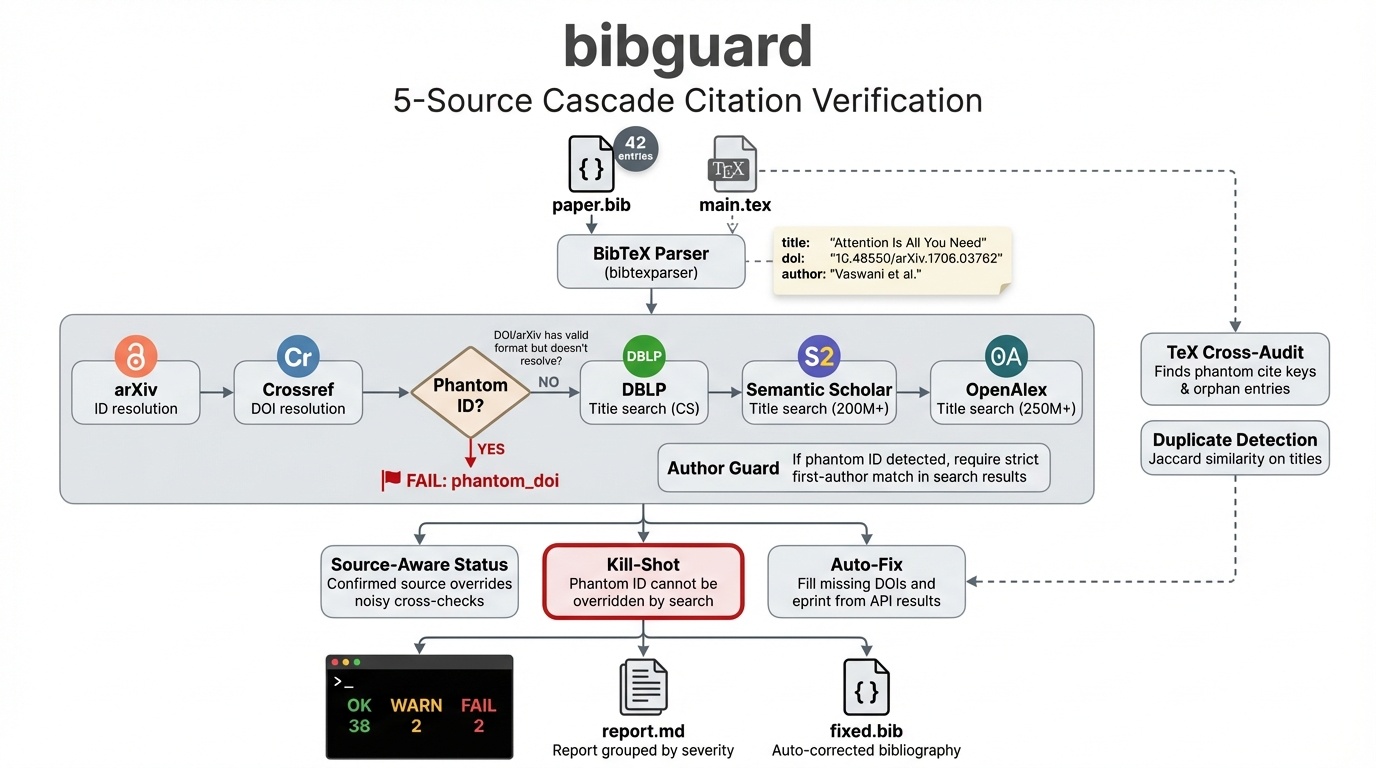
Try it now
Paste BibTeX entries below. Verification runs entirely in your browser — no data leaves your machine.
Features
5-Source Cascade
arXiv, Crossref, DBLP, Semantic Scholar, OpenAlex. Falls back gracefully across sources.
Phantom ID Detection
DOIs and arXiv IDs that look valid but don't resolve — the strongest hallucination signal.
Kill-Shot Logic
A phantom ID cannot be overridden by a similar search result. No false negatives on fabricated identifiers.
TeX Cross-Audit
\cite{key} with no .bib entry, and orphan entries never cited. (Python version)
Auto-Fix
Corrected .bib with missing DOIs and eprint IDs filled in from API results.
Browser-Native
TypeScript version is zero-dependency. All 5 APIs support CORS — no proxy needed.
Benchmark
v0.3.0 — validated on 200 entries sampled from crawled datasets. Reproduce it yourself.
| Category | N | Key Metric |
|---|---|---|
| Hallucinated | 50 | 100% detected (all FAIL) |
| Chimera | 50 | 100% detected |
| Real papers | 50 | 0% false positive, 86% clean OK |
| Retracted | 50 | 2% flagged (L0 limitation) |
Also validated on 58-case golden test set: 14/14 hallucinations caught, 5/5 chimeras detected.
API Sources
No API keys required. All support CORS for browser use.
AI Assistant Integration
Skill definitions for major AI coding assistants.
/bibguard paper.bib/bibguard paper.bibauto on .bib/.texbibguard --jsonNeed deeper verification?
bibguard handles L0 (existence & metadata verification). For semantic NLI, citation intent classification, graph anomaly detection, and Bayesian risk scoring, see IntegriRef — the full L0-L4 verification stack.